
Shared memory is not the same as shared working state
Memory is optimized for future recall. It keeps durable facts, lessons, and procedures that remain useful beyond one task.
A handoff is optimized for continuation. Unfinished work often depends on details that would make poor durable memories: what was attempted, which option was rejected, where the draft lives, and what should happen next.
Putting all of that into normal memory would pollute later searches. Leaving it only in a transcript makes the next conversation reconstruct the state. Handoffs keep this temporary-but-important context in its own bounded artifact.
What a useful handoff contains
A good handoff is a structured distillation, commonly including:
- A short name and summary.
- Completed and remaining work.
- Decisions and the rationale that must not be smoothed away.
- Blockers or unresolved questions.
- The next concrete action.
- Pointers to relevant memories and artifacts.
The handoff should be compact enough to inject into a fresh context. It references deeper material rather than duplicating every source.
Ask the current assistant to save the work
The assistant distills the current state and calls Angareion's handoff save capability.
Open another connected conversation
The destination may be a new chat in the same product or a different AI tool connected to the same Angareion agent.
Find and resume the handoff
The assistant can list recent handoffs or search by name and description. Resuming returns the canonical brief.
Continue from the next action
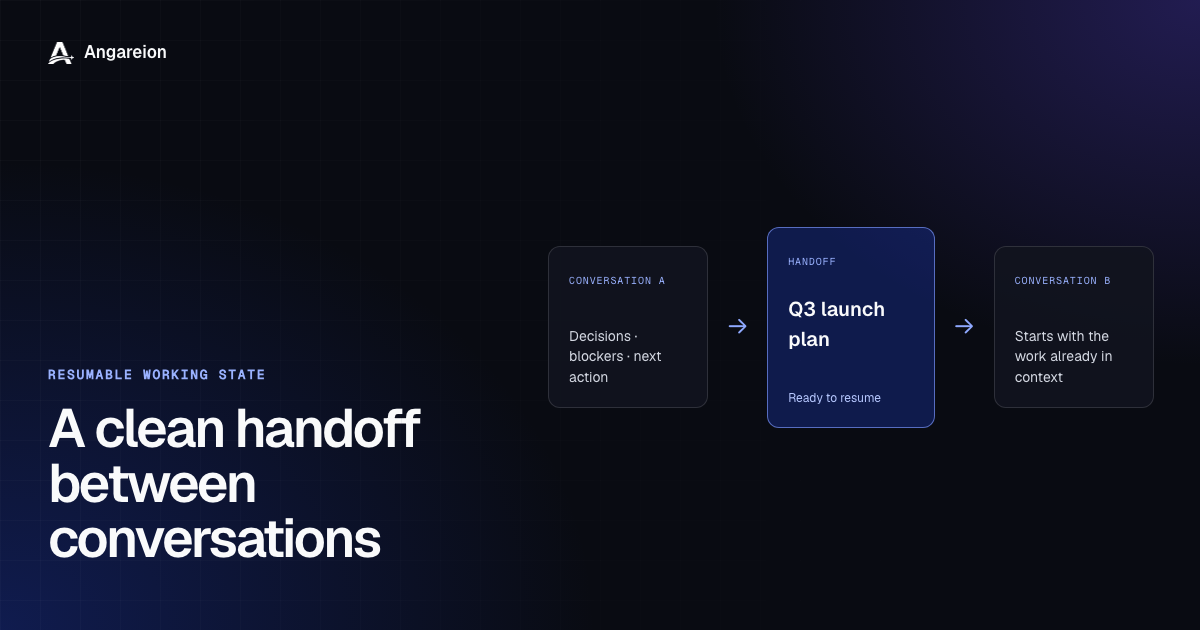
The new conversation begins with the brief in context instead of asking the user to recreate the project history.
Moving a launch plan from Claude to ChatGPT
Claude saves a handoff named “Q3 launch plan.” It records the chosen audience, two rejected taglines with rationale, a legal-review blocker, and the next action: draft the announcement email. In ChatGPT, the user asks to resume that handoff. The new conversation starts at the email draft rather than revisiting the audience decision.
Why Angareion does not save raw transcripts
Raw transcripts are large, noisy, and likely to contain instructions or side conversations that should not silently become future context. Distillation is part of the product: it produces a bounded brief suited to resumption.
Handoffs are also isolated from normal memory search. They have their own lifecycle and can expire unless retained. That prevents unfinished working state from masquerading as durable organizational knowledge.