
Learning means creating useful future context
For an AI memory system, “learning” should not mean retaining everything. Most conversation text is temporary: brainstorming, corrections, abandoned options, copied source material, and instructions that apply only to the current turn.
Angareion treats learning as a selection process. The question is not “What text appeared?” It is “What durable, non-obvious context would improve future work?”
That might be:
- A confirmed customer preference.
- A procedure that solved a recurring problem.
- A decision and why the team made it.
- A durable fact extracted from an approved source.
- A reflection that synthesizes several related experiences.
The guided session-capture flow
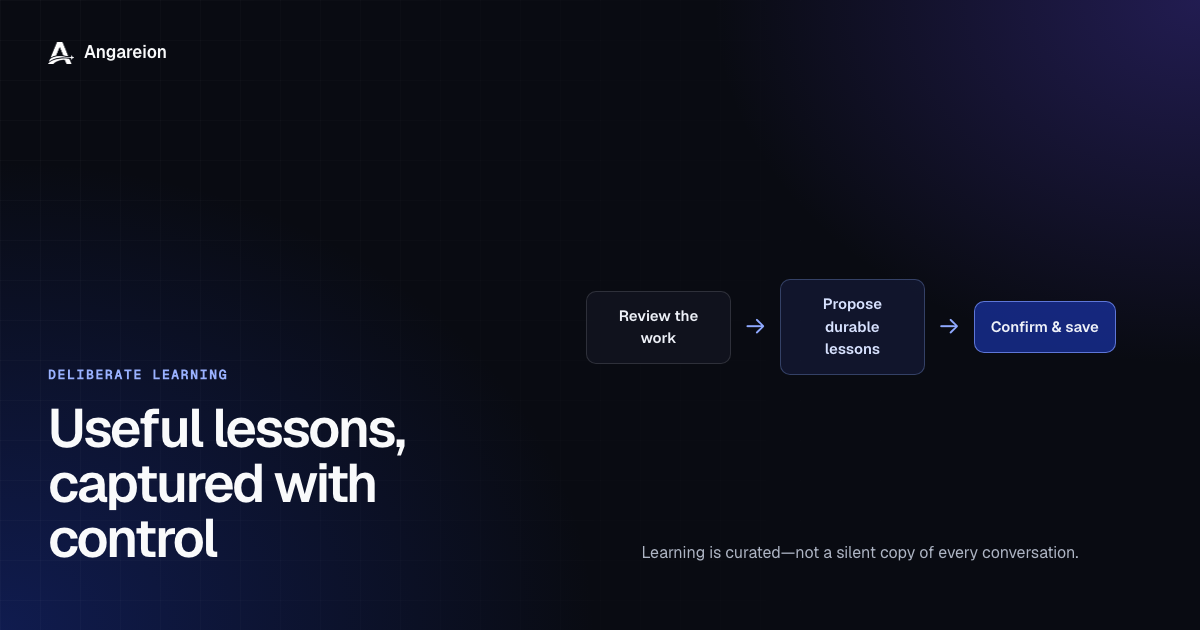
When asked to capture lessons from a session, a capable connected assistant follows a reviewable flow.
Review the conversation
The assistant identifies candidate lessons that appear durable, specific, and useful beyond the immediate task.
Search for existing memory
Before creating another record, it checks for likely duplicates or an existing memory that should be refined instead.
Present the candidate
The user can see what would be saved, including the proposed type and content. Tentative conclusions should remain tentative.
Confirm, save, and relate
Approved candidates are saved. When useful, the new memory can be related to an existing one as a refinement, support, contradiction, synthesis, or other explicit relationship.
Turning troubleshooting into a reusable procedure
A team spends an hour discovering that an OAuth client must use PKCE and Dynamic Client Registration. At the end, the assistant proposes a procedural memory describing the verified setup and a semantic memory explaining why static credentials are not required. The user confirms the procedure and rejects a speculative third candidate.
Learning from documents
Conversations are not the only source. Angareion can ingest documents and URLs into named knowledge sources. The document pipeline preserves source identity and can extract structured memory from approved material.
This creates an important distinction:
- Knowledge preserves what the source says and supports grounded retrieval.
- Memory captures a durable fact, lesson, or procedure that can participate in the memory lifecycle.
Keeping source-backed knowledge available helps reviewers verify a learned memory and revise it when the source changes.
Learning continues through curation
Saved memory is not frozen forever. Teams can revise it, relate it to other memories, promote it to a broader audience, mark stale information, and resolve competing versions. Confidence and importance can change as evidence accumulates.
This is organizational learning rather than transcript accumulation: the memory becomes more useful as it is reviewed and connected.
A good learning habit
At the end of meaningful work, ask: “Which lessons from this session are durable enough to save?” Review the candidates, keep the smallest useful set, and use the narrowest appropriate scope.