
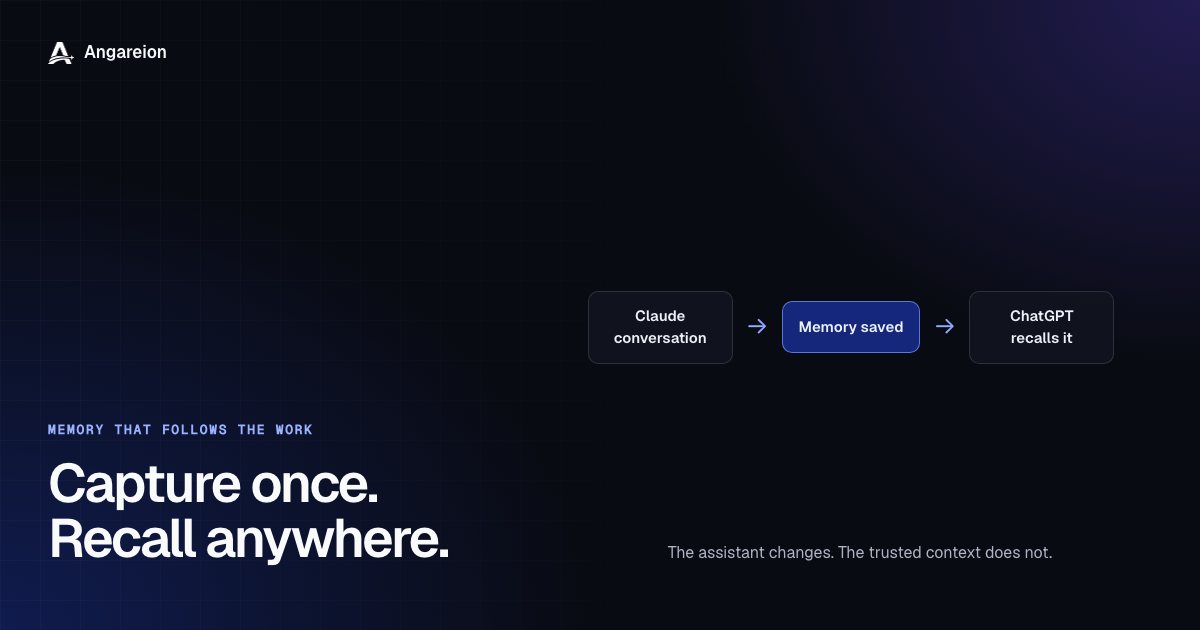
Memory lives outside the chat
Every AI product has its own way of handling conversation history. That history may help inside the same product, but it is rarely a dependable, governed memory system for all of a team's tools.
Angareion keeps durable memory outside those interfaces. A connected assistant receives explicit capabilities such as memory_create, memory_search, and memory_get. Those tools let it write a structured record and retrieve relevant records later.
The chat remains the place where people work. Angareion becomes the place where selected context persists.
The capture-and-recall loop
Capture what is worth keeping
The user or assistant identifies a durable fact, decision, preference, or procedure and saves it as a structured memory.
Store context with useful signals
The memory includes its type and scope, plus confidence and importance signals. Those fields help Angareion decide how the memory should be governed and ranked.
Search by meaning
A later conversation asks a natural-language question. Angareion searches memories the caller is allowed to access and returns the most relevant context.
Answer with traceability
The assistant uses the returned memory to answer. When source information is available, it can preserve the path back to the supporting material.
Switching assistants without re-onboarding
In Claude, you save: “For enterprise pilots, security review starts before commercial negotiation.” Later, in ChatGPT, you ask: “What sequence did we decide on for enterprise pilots?” The wording is different, but semantic search can still retrieve the saved procedure.
Shared does not mean universally visible
The word “shared” describes the infrastructure, not the audience of every record. An agent-scoped memory remains private to its owning agent. A team-scoped memory can be recalled within the selected team. Institutional memory is available more broadly within the organization.
This matters because cross-tool access should not flatten governance. The same identity and authorization rules follow the memory into each connected interface.
How retrieval chooses useful context
Keyword search alone misses paraphrases. Pure vector similarity can retrieve text that sounds relevant but is weak, stale, or outside the user's intended scope.
Angareion runs both at once and adds a third leg. A search fans out across keyword matching, semantic (vector) similarity, and the relationships between memories, then fuses the results. On top of that, the memory model carries additional signals—confidence, recency, importance, source context, and memory status—that shape whether a memory should surface. The system is designed to manage a memory lifecycle, not just return the nearest embedding.
Start with deliberate capture
The best early memories are facts or decisions you are tired of repeating. Capture them in plain language, assign the narrowest useful scope, and test recall from a fresh conversation. Quality and clarity matter more than volume.