
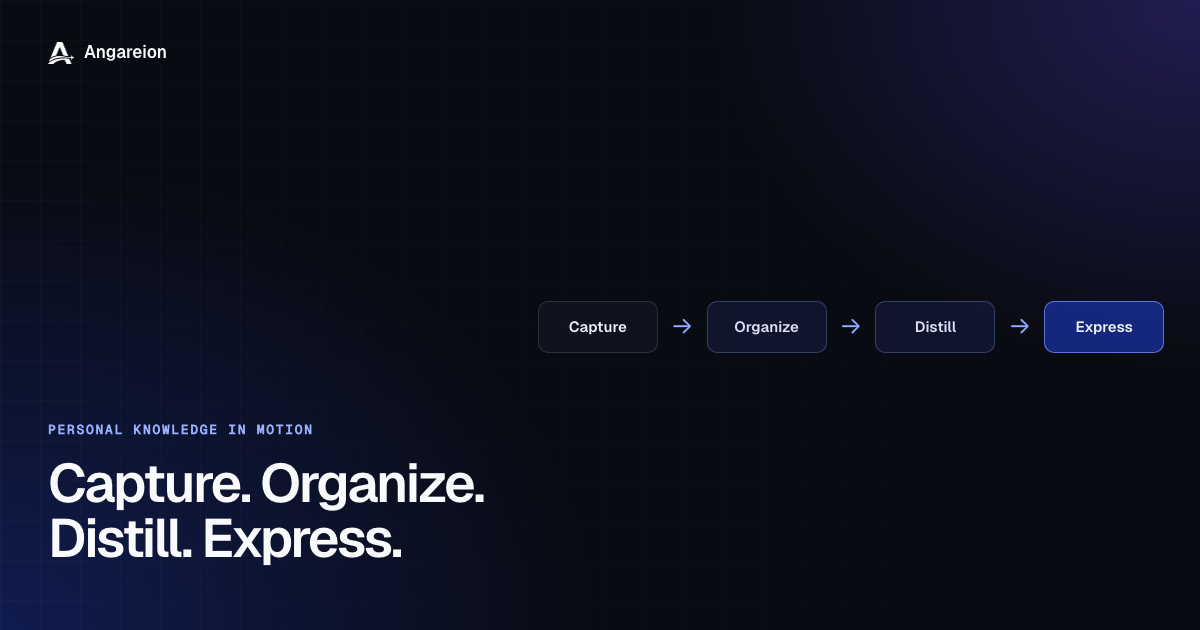
What is the CODE framework?
Tiago Forte's CODE method is a four-part personal knowledge-management workflow for turning information into useful output. The stages are flexible rather than a rigid software specification:
- Capture what is worth preserving.
- Organize it for the work it can support.
- Distill the most useful meaning.
- Express it through decisions, deliverables, and creative work.
Angareion does not redefine CODE or perform every stage without judgment. It provides memory and knowledge capabilities that a person or connected assistant can use while practicing the method.
Capture: preserve what will matter again
Capture is selective. In Angareion, a connected assistant can save a durable memory, guide the user through candidate lessons from a session, ingest an approved document or URL as knowledge, or save unfinished work as a handoff.
The choice of container begins at capture. A verified customer requirement may become semantic memory. A reference manual belongs in a knowledge source. The state of a half-finished proposal belongs in a handoff.
Organize: add behavior, audience, and provenance
Folders are only one way to organize knowledge. Angareion adds structure that affects how context behaves:
- Memory type distinguishes facts, experiences, procedures, entities, reflections, and other forms.
- Scope controls whether an agent, team, or institution may recall it.
- Sources and metadata preserve where knowledge came from.
- Relationships connect refinements, support, contradictions, citations, and related ideas.
- Specialists and knowledge sources assemble approved context around recurring kinds of work.
This makes organization useful at retrieval time. The system can filter inaccessible material and help surface context suited to the question instead of requiring the user to remember a folder path.
Distill: turn raw material into durable understanding
Distillation is the difference between retaining a transcript and learning from it. During guided session capture, an assistant identifies candidate lessons, searches for related memory, presents the proposed wording, and saves only what the user confirms.
Existing memory can be revised, related, promoted, or consolidated as understanding improves. The goal is not to erase nuance; it is to preserve the conclusion, rationale, source, confidence, and boundaries needed by a future user or assistant.
Express: put context back into action
Expression happens when stored context contributes to something new. A connected assistant can recall a prior decision while drafting a plan, search source-backed knowledge while answering a question, load a specialist for a repeatable workflow, or resume a handoff and finish the next action.
The output may be a document, design, decision, analysis, support response, or code change. Angareion supplies relevant context; the person and their chosen AI tool still shape the result.
Using CODE for a launch brief
The team captures interview notes and an approved market report. It organizes the report as source-backed knowledge and saves confirmed positioning decisions at team scope. A guided review distills recurring objections into three concise memories. Later, a connected assistant recalls those memories and cites the report while helping express the work as a launch brief.
CODE is a cycle, not a one-way pipeline
Capture a useful signal
Save a decision, lesson, source, or handoff when it becomes valuable.
Organize it for future access
Choose its type, audience, source, and relationships.
Distill as understanding improves
Revise or consolidate the material without losing provenance.
Express something useful
Recall the context in a real project, then capture what the new work teaches.
The result of expression often creates the next round of capture. That feedback loop is how a second brain becomes more useful through application rather than merely growing larger.