
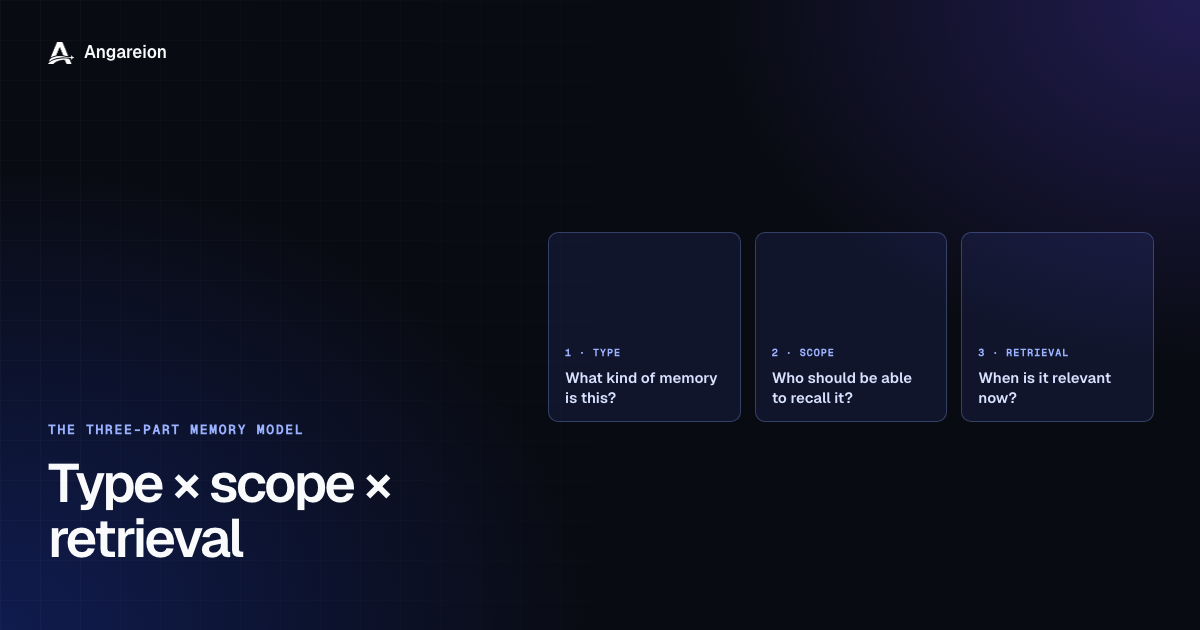
This is sometimes described informally as Angareion's “triple memory” model. It does not mean three separate memory stores; it means every useful memory is understood through these three dimensions.
1. Type: what kind of memory is this?
Different knowledge should behave differently. A single event is not the same as a consolidated fact, and neither is the same as a reusable procedure.
Angareion supports structured memory types including:
- Episodic — something that happened in a particular situation.
- Semantic — a fact or conclusion expected to remain useful.
- Procedural — a repeatable way to accomplish something.
- Entity — durable knowledge about a person, product, organization, or other known thing.
- Reflection — a considered summary or synthesis of prior experience.
- Reasoning — a retained reasoning artifact when that form is appropriate and permitted.
Choosing the type communicates how the memory is likely to be used. A customer preference may be semantic. A troubleshooting sequence may be procedural. The outcome of one incident may begin as episodic and later support a broader reflection.
2. Scope: who should be able to recall it?
Scope is the governance dimension. Angareion distinguishes:
- Agent scope for memory private to one agent identity.
- Team scope for context intentionally shared with a team.
- Institutional scope for knowledge meant to serve the wider organization.
Scope is not a relevance score. A highly relevant memory can still be unavailable because the caller is outside its audience. Angareion checks access before retrieval results reach the assistant.
3. Retrieval: when does this memory matter?
When an assistant searches, Angareion does more than look for the same words. Semantic search helps match meaning, while signals such as confidence, importance, recency, memory status, and source context help rank what should surface.
This is why two memories with similar text do not have to be treated as equally useful. One may be verified and current; the other may be tentative or superseded.
Classifying a support lesson
“Customer Acme requires a maintenance notice 72 hours before deployment” is a semantic memory. It may begin at agent scope while being checked, then be promoted to the account team's scope once confirmed. A later search for “What advance notice does Acme need?” can retrieve it even though the wording differs.
Confidence and importance are separate
Confidence asks, “How sure are we this is accurate?” Importance asks, “How much should this matter to the work?”
A confirmed office address can be high confidence and low importance. An unverified warning about a severe production risk can be lower confidence but high importance. Keeping these signals separate gives retrieval a more honest picture.
What the model does not mean
The three-part model is not three copies of the same record and not three separate chats. It is a practical way to describe each memory's meaning, audience, and recall behavior.