
What “second brain” means here
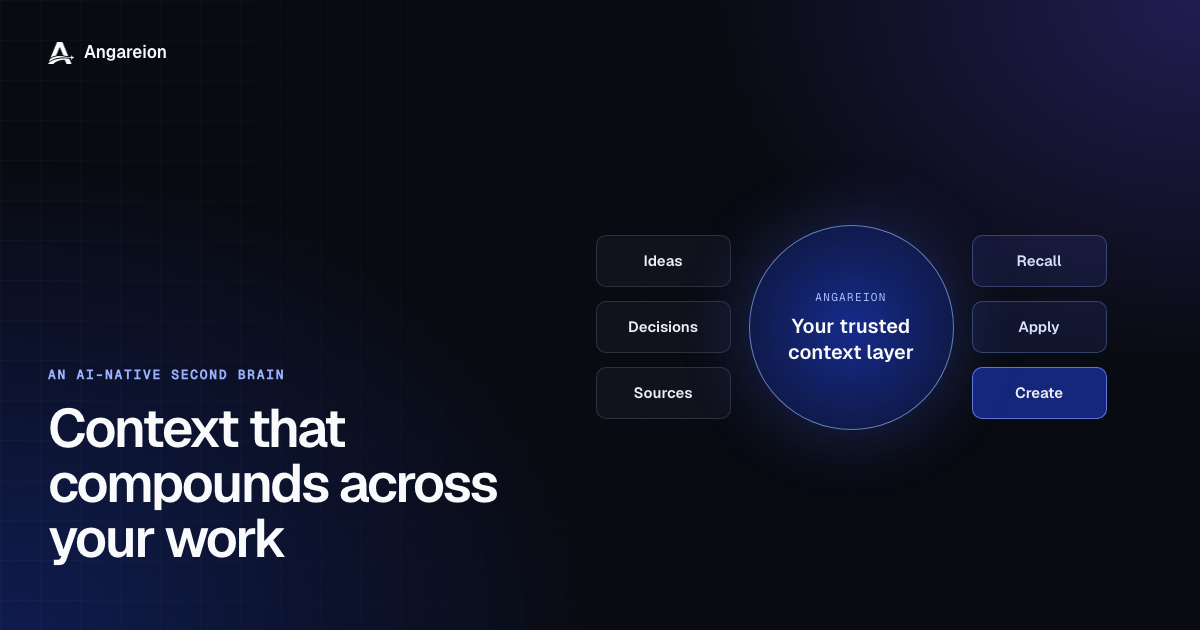
The Building a Second Brain approach describes a second brain as an external system that preserves useful ideas and helps turn them into action. Angareion applies that principle to AI-powered work: it gives connected assistants and agents a durable context layer outside any one conversation.
That distinction matters. A chat history is a record of what was said. A second brain is a deliberately maintained system for finding and applying what remains useful.
Angareion can hold several forms of that context:
- Memories for durable facts, decisions, procedures, entities, experiences, and reflections.
- Knowledge sources for documents and web material that answers should remain grounded in.
- Handoffs for unfinished working state that another conversation should resume.
- Relationships and revisions that show how understanding develops instead of flattening every note into one pile.
Set up the capture-and-recall loop
Connect the AI tools where work already happens
Add Angareion to one supported assistant through MCP, then connect the other tools where you want the same context available. The goal is not to replace those interfaces; it is to give them a shared memory layer.
Decide what deserves capture
Save information that is durable, non-obvious, and likely to improve future work. Good candidates include confirmed preferences, decisions with rationale, repeatable procedures, important entity context, and lessons from completed work. Avoid saving every brainstorm or temporary instruction.
Use the narrowest useful audience
Start private at agent scope when context is personal or still being checked. Promote it to a team or institutional audience only when it is accurate and genuinely useful more broadly.
Begin new work with recall
Ask the connected assistant to search Angareion before reconstructing prior decisions from memory. Recall is what converts stored information into working context.
Review and curate
Correct stale information, relate supporting or contradictory memories, consolidate duplicates, and preserve source context. Trust grows from maintenance, not volume.
A product lead's second-brain loop
A product lead uses Claude to analyze interviews, saves a confirmed onboarding problem as semantic memory, and ingests the approved research report as knowledge. A week later, she begins a roadmap draft in ChatGPT. It recalls the saved problem and searches the original source before helping her write. When the team confirms the finding, she promotes the memory from agent to team scope.
Keep memory, knowledge, and handoffs distinct
A useful second brain has more than one container because not all context should behave the same way.
Use memory when a lesson should be available in future work. Use knowledge when the source itself must remain searchable and traceable. Use a handoff when the immediate goal is to continue one unfinished task with its blockers and next action intact.
This separation keeps temporary project state out of long-term recall while preserving the evidence behind durable conclusions.
A practical first week
Start with one real project. Capture three to five durable items, recall them from a fresh conversation, and correct anything that is unclear. That small test reveals whether your capture criteria, titles, scopes, and source links are useful before you expand the system to the rest of your work.