
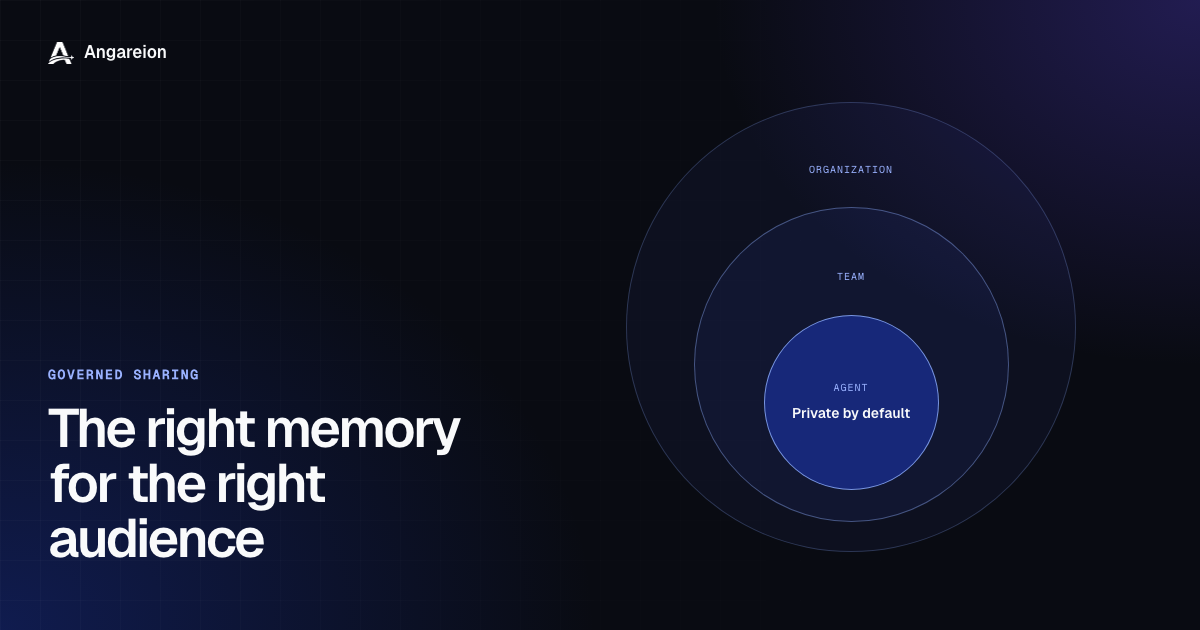
Why memory needs an audience
An external memory layer makes context portable across AI tools. Without an audience model, portability could become uncontrolled disclosure.
Angareion keeps retrieval and authorization together. A connected assistant can only receive memories its current identity is allowed to access. Changing from one AI interface to another does not remove those boundaries.
Agent scope
Agent scope is the narrowest audience and the default for personal working memory. It is useful for:
- Early observations that have not been verified.
- Preferences belonging to one person's assistant identity.
- Draft procedures still being tested.
- Context that is useful across that agent's conversations but not ready for broader use.
Multiple AI clients can bind to the same Angareion agent. In that case, the agent-scoped memory can follow the user across those clients without becoming team-wide knowledge.
Team scope
Team scope makes a memory available to the agents and people operating within a selected team. It is appropriate for context such as account practices, campaign decisions, engineering runbooks, or domain-specific terminology.
The team should be the real audience—not merely a convenient way to make a result easier to find.
Institutional scope
Institutional memory is intended for knowledge that should be broadly reusable across the organization. Examples include approved policies, company-wide terminology, shared operating principles, and verified facts that multiple teams need.
Because this is the widest audience, organizations may apply additional governance before promotion.
Promoting a customer preference deliberately
A sales agent records an unverified preference at agent scope. After the account owner confirms it, the memory is promoted to the account team's scope. It does not need institutional scope because teams outside the account do not need it.
Promotion only widens access
Angareion's promotion flow widens a memory from agent to team or institutional scope. This should be a deliberate act: it changes who can receive the memory in future searches.
If a memory was shared too broadly, the safe correction is to archive or remove the broad record and create a properly scoped replacement. This avoids pretending that information already exposed was never shared.
Scope and sensitivity are related but different
Scope answers who may receive a memory. Sensitivity describes the handling requirements of the information itself. A memory can be intended for a whole team and still contain material whose sensitivity prevents that promotion under organizational policy.