
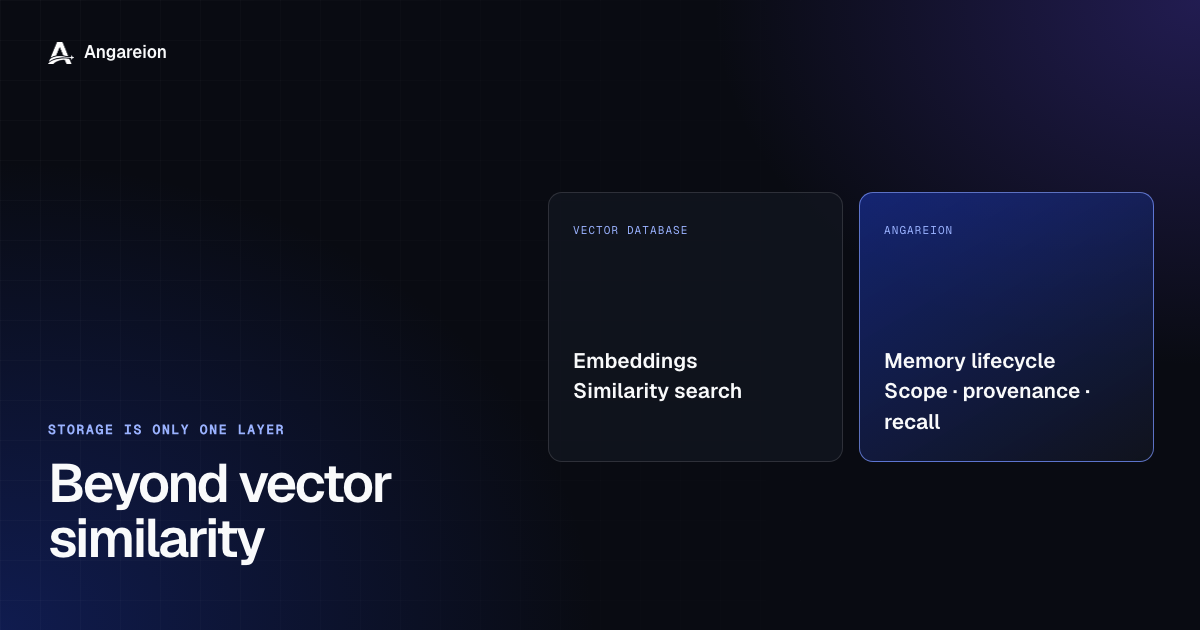
What a vector database does well
A vector database stores embeddings: numeric representations of content. Given a query embedding, it can efficiently return nearby vectors whose content is semantically similar.
That capability is valuable. It lets a search for “enterprise onboarding sequence” find text about “the order used to activate large customers,” even when the keywords differ.
But the nearest vector does not automatically answer several product questions:
- Is the result still current?
- Is the caller allowed to see it?
- Is it a fact, an experience, or a procedure?
- How confident is the organization in it?
- What source supports it?
- Has another memory superseded it?
- Should an AI assistant receive it in this context?
Those concerns have to be implemented around the database.
What Angareion adds
Angareion manages the context as a memory with a lifecycle, not just a vector and a payload.
Structure. Memory types distinguish facts, procedures, episodes, entities, reflections, and other supported forms.
Governance. Scopes control whether memory is private to an agent, shared with a team, or available institutionally.
Hybrid retrieval. Recall does not rely on vector similarity alone. Angareion fuses three signals of relevance: keyword search for exact terms, vector search for meaning, and the memory graph for how records relate. Vector search is one leg of that, not the whole of it.
Quality signals. Confidence, importance, recency, source context, and status then influence how the retrieved candidates are ranked.
Provenance and relationships. Memories can retain source references and explicit relationships to other memories.
Curation. Teams can revise, promote, relate, supersede, or remove memory through controlled workflows.
AI-native access. MCP tools let supported assistants capture and recall context without every team building a custom integration for every provider.
Why similarity is not enough
Two memories are equally similar to “What discount did we approve?” One is a tentative 20% proposal from last month. The other is a verified 15% decision that superseded it yesterday. A vector-only lookup may treat them as close neighbors. A memory system needs status, time, confidence, and relationships to prefer the right one.
Does Angareion replace a vector database?
Not necessarily. Vector search is part of Angareion's implementation and can also remain part of an organization's broader architecture. The distinction is product responsibility: Angareion provides the memory behavior and governance above the storage primitives.
If a team already has a vector database, the practical question is whether it also wants to build and maintain identity, scope enforcement, memory schemas, curation, citations, cross-tool access, and lifecycle behavior. Angareion is designed to provide that complete context layer.